


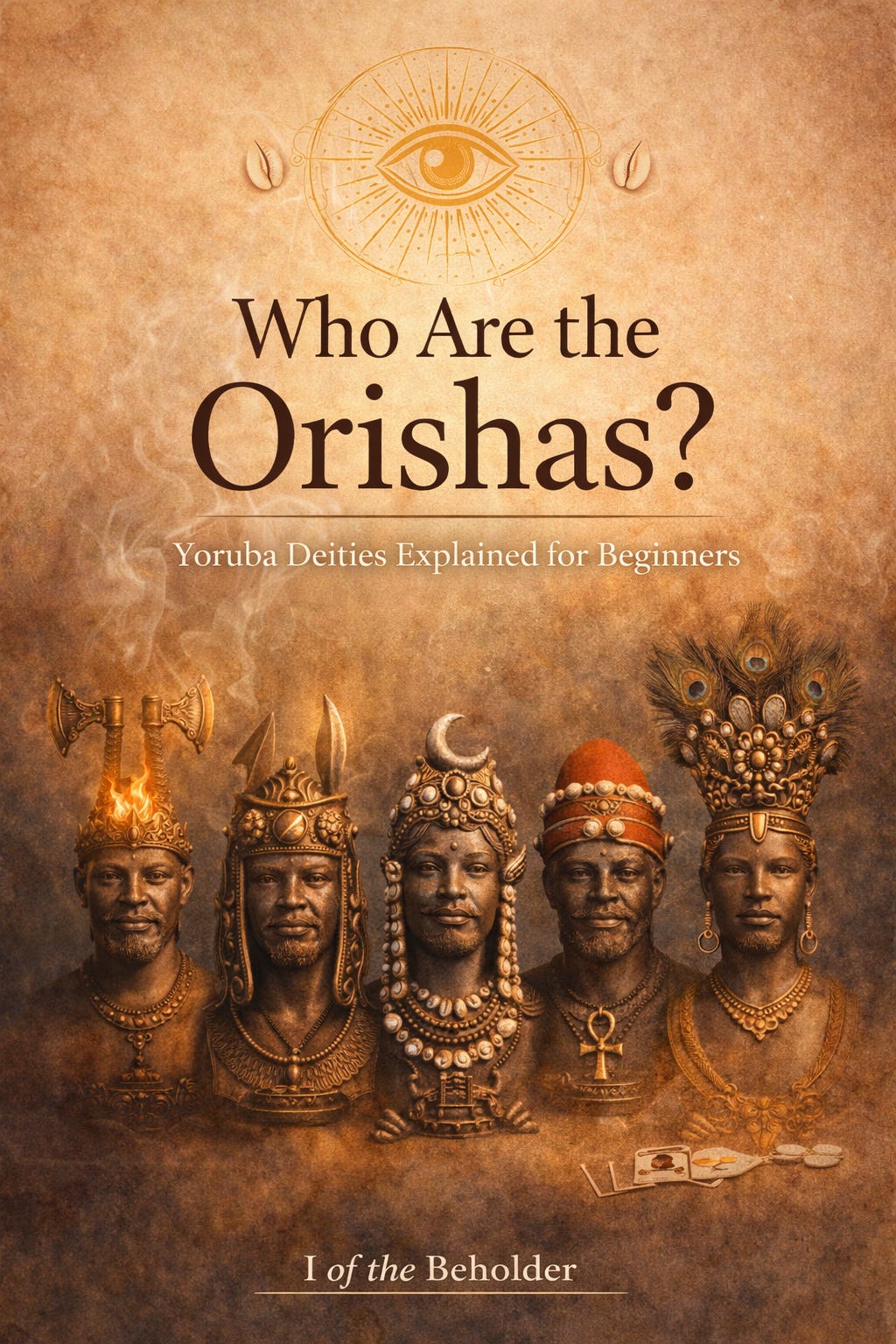
If you’ve spent any time exploring African spirituality, you’ve probably encountered the word Orisha. Maybe in passing, maybe in a serious conversation, maybe because something about it pulled at you in a way you couldn’t quite explain. Whatever brought you here, this is a good place to start.
The Orishas are divine beings in the Yoruba spiritual tradition, originating from what is now Nigeria and Benin in West Africa. They are not gods in the distant, untouchable sense that word sometimes implies. They are more like divine intermediaries - beings of immense spiritual power who exist between the human world and Olodumare, the Supreme Being (the source of all creation). They are forces of nature, aspects of human experience, and living presences that interact with the world in very real ways.
There are hundreds of Orishas, though a smaller number are widely known and widely venerated across the diaspora. Each governs a particular domain of life and nature such as rivers, iron, wind, the ocean, the crossroads, healing, and thunder. Furthermore, each has a distinct personality, set of attributes, colors, numbers, and offerings associated with them.
Where the Orishas live
The Yoruba tradition teaches that Olodumare created the Orishas and sent them to earth as caretakers of the world and guides for humanity. Some Orishas are seen as having once walked the earth in human form. Others are pure elemental forces who have always existed as spirit. All of them are accessible through relationship.
That word, relationship, is important. Working with the Orishas is not about appealing to a hierarchy of deities and hoping for favor. It is about cultivating a genuine, ongoing connection with spiritual forces that are already present in your life, whether you’ve acknowledged them or not.
A few of the most widely known Orishas
Eshu, also known as Ellegua, Elegba, Elegbara or Legba in some traditions, is the Orisha of the crossroads, communication, and beginnings. He is always the first to be acknowledged in ceremony because nothing opens - no door, no conversation, no path forward - without his blessing.
Yemoja is the mother of waters, the Orisha of the ocean (at least in modern times) and of motherhood. She is protective, nurturing, and vast. Many people feel drawn to her without even knowing her name.
Shango is the Orisha of thunder, lightning, and justice. He is powerful and commanding, and his energy is unmistakable in people who carry him.
Oshun governs fresh water, love, sensuality, and abundance. She is often the first Orisha to capture people’s attention, and there is a reason for that - she meets you where you are.
Ogun is the Orisha of iron, labor, and the clearing of obstacles. He governs all things built with metal - tools, vehicles, surgery, warfare. His energy is direct and relentless.
Obatala is the Orisha of creation, purity, and wisdom. He is associated with clarity of thought and the molding of human form. Elders, people who work with the mind, and those seeking peace often find a natural affinity with him.
The Orishas across the diaspora
When enslaved Africans were brought to the Americas, they carried their traditions with them. Under extraordinary pressure to abandon their beliefs, many found ways to preserve them, sometimes, by syncretizing the Orishas with Catholic saints as a layer of protection. This is why in Cuban Lucumí, Brazilian Candomblé, and other diaspora traditions, you’ll find the Orishas still alive, still being venerated, still answering.
The tradition did not die. It traveled, adapted, and survived. That resilience is part of its power.
What this means for you
You do not have to be initiated, or even from a Yoruba lineage, to feel the presence of the Orishas in your life. Many people come to this tradition because something in it recognizes them, be that a pull toward a particular element, a repeated encounter with certain themes, or a sense of being claimed by something they can’t name.
If that resonates, pay attention to it. The Orishas have a way of making themselves known. Most importantly, contact a qualified elder to help you navigate the complexities of Yoruba spirituality.
Want to go deeper? Subscribe to be notified when articles are posted and feel free to contact Papa Eli directly.
.
Abundance,good character and long life