


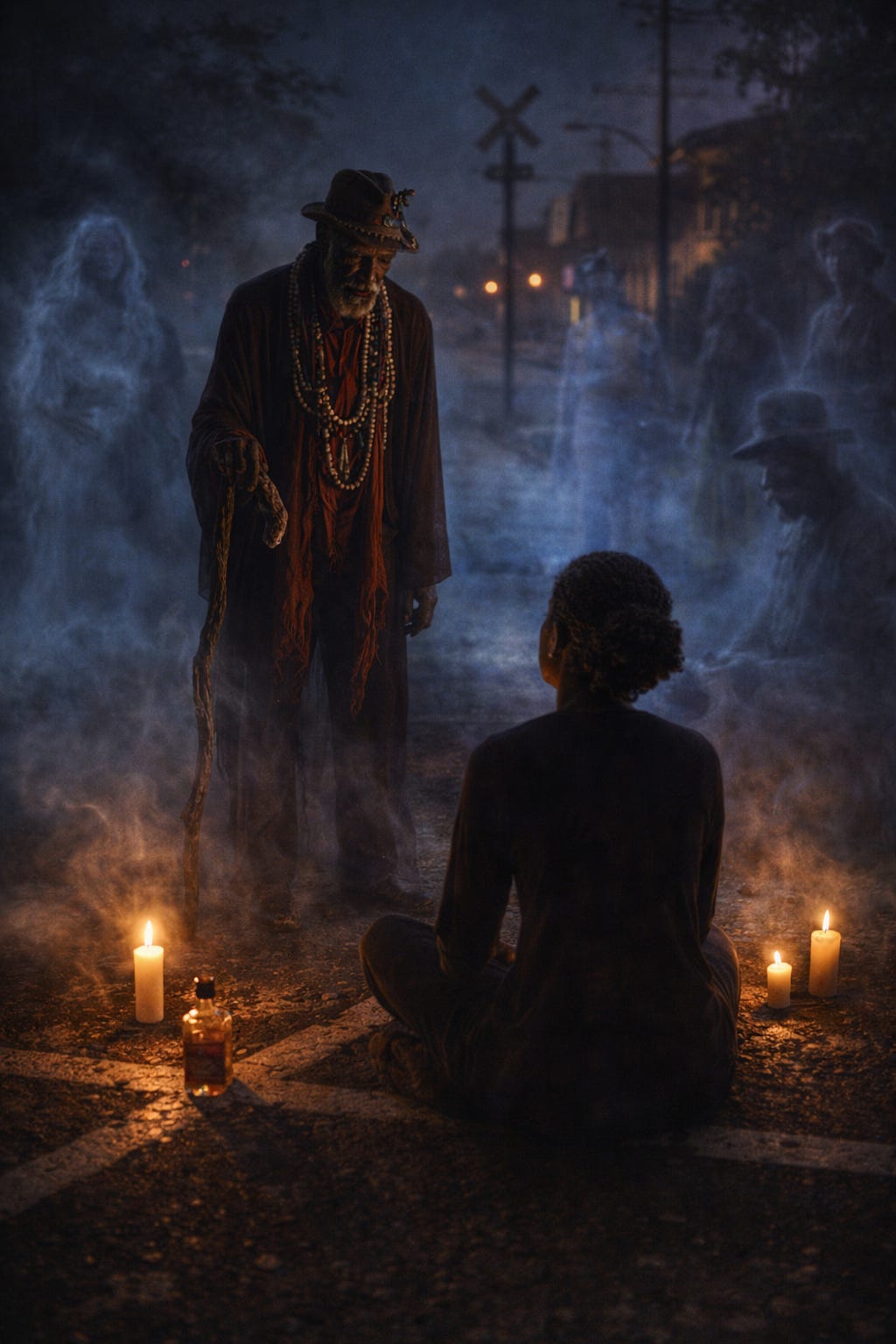
Louisiana Vodou is widely misunderstood as a tradition of curses and dark workings, a reputation built more on Hollywood than on anything resembling the actual practice. That mischaracterization does a real disservice to one of the most spiritually sophisticated traditions to take root on American soil. Relationship with the divine, with the ancestors, with the natural world, and with the spirits who govern it are at the core of the belief system, and its that relationship on which most practitioners focus their energy.
What is Louisiana Vodou?
Louisiana Vodou carries the living imprint of several converging streams. West African spiritual traditions (primarily from the Fon and Ewe peoples of Dahomey) form its deepest roots. However, Haitian Vodou arrived in New Orleans through Saint-Domingue refugees in the early nineteenth century along with Yoruba inspired traditions like Santeria and shaped the tradition profoundly. French Creole culture, Indigenous knowledge, and the syncretic overlay of Catholicism each left their mark as well, shaping how these spirits were understood and honored in public life. The result is a tradition with its own character and that belongs to Louisiana as surely as the bayou does.
Who the Lwa and the Orisha Are
The Lwa are the intermediary spirits of the Vodou tradition. They stand between humanity and the supreme creative force, known in some branches as Bondye, who is understood to be too vast and complete to engage with human affairs directly. The Lwa are the ones who answer. Each one governs specific forces of nature and human experience, and each one has a distinct personality, set of preferences, and way of making themselves known.
The Orisha are the divine emissaries of the Yoruba tradition, each one governing a specific force of nature and dimension of human life. They too serve as intermediaries, each one an expression of Olodumare, the supreme creative source, and each one intimately concerned with the lives of those who honor them.
What the Lwa and the Orisha share is this: they are not distant, they are not abstract, and they are not indifferent. They are powerful, present, and in relationship with those who call on them.
What They Govern
Its worth noting that what follows is far from a comprehensive list of the powers honored in Louisiana Vodou. These are, however, some of the most widely known and venerated. With that in mind, lets continue.
Papa Legba stands at the crossroads and holds the key to every gate. No spirit can be reached without first calling on him, because he governs all passage between the human world and the spirit world. He is depicted as an old man, unhurried, leaning on his staff, and his age is a sign of wisdom. Elegua or Eshu governs the same crossroads from the Yoruba stream. He too is the opener of roads, the spirit of beginnings and endings, the first to be called and the last to be thanked.
Obatala is the Orisha of purity, clarity, and wisdom. He is associated with white cloth, with the cool stillness of deep knowing, and with the creation of human form. He governs the mind and calls those who work with him toward patience and discernment.
Yemaya is the mother of waters, governing the ocean and the mysteries held within it. She is protective and vast, fierce when her children are threatened, and generous in her nurturing. She governs birth, the subconscious, and the deep emotional currents that run beneath the surface of a life.
Oshun governs the fresh waters, love, sweetness, abundance, and the kind of beauty that is also power. She is honey and river current, sensual and strategic, and she governs the places where love and prosperity meet.
Shango governs thunder, lightning, justice, and the authority that comes from righteous power. He is a king, and he carries the double-headed axe that cuts through deception. Those who call on him are calling on fire and truth in equal measure.
Ogun governs iron, labor, and the force required to clear a path where none existed. He is the Orisha of the machete and the railroad track - of all work done with the hands and the will. His Louisiana counterpart, Ogou, shares that energy, governing iron, fire, and the battles of principle that require a person to stand firm regardless of the cost.
Ochosi governs the hunt, justice, and the ability to find what is needed. He moves with precision and patience. Those who need clarity in legal matters or resolution in situations where they have been wronged will find him a steady ally.
Erzulie Freda governs love, beauty, and the tender aching places of the heart. She is refined and generous and capable of deep sorrow. Her grief is as much a part of her nature as her sweetness. She governs what humans long for most and sometimes cannot reach.
Oya governs wind, storms, and the force of change that cannot be stopped or negotiated with. She rules the cemetery gates alongside Baron and governs the kind of transformation that arrives whether you are ready or not. She is the Orisha of endings that make way for beginnings. Those who work with her learn that what she sweeps away needed to go.
Oshumare governs the rainbow, continuity, and the movement between the heavens and the earth (this also make him an Orisha of divination in some lineages). He is associated with transformation, with the cycles that sustain life, and with the flow of wealth and abundance through the world. His presence bridges realms, and his energy is one of perpetual movement and renewal.
Damballah is among the oldest of the Lwa, the great serpent of the sky, associated with purity, ancient wisdom, and the waters above the earth. His presence cools and renews, and his wisdom is so old it does not always come in words.
Baron Samedi holds the gate of death with an irreverent joy that unsettles those who have never stood close to mortality long enough to understand it. He governs the dead, the cemetery, and the bawdy, unflinching wisdom that comes from knowing exactly how short life is. Maman Brigitte stands beside him, governing death and healing. She is of the few Lwa of European origin to be fully absorbed into the tradition. She watches over the graves of the righteous.
How They Communicate
One of the most striking truths about Louisiana Vodou is how actively present these spirits make themselves, and how many channels they use to reach those who are in relationship with them.
Possession is the most well-known form of communication. During ceremony, a Lwa may descend into a practitioner, mounting them the way a rider mounts a horse, and when that happens, the spirit is present in a tangible, embodied way. They speak, they counsel, they heal, and they correct.
The Orisha and Lwa also speak through dreams, and a genuine visitation carries a weight and clarity that the dreamer does not forget. They speak through signs in the natural world such as a particular bird, a flame that moves in a peculiar way, or a stillness that settles where there was noise. Learning to read their language is part of the relationship.
Divination is another avenue. A skilled reader working within the tradition can bring through guidance from the Lwa and the Orisha, and consulting someone rooted in this work is one of the ways people access that clarity when they need it most.
The thread running through all of these channels is relationship. The spirits communicate most clearly with those who honor them, who call on them, and who pay attention.
Finding Your Way
If you feel drawn to the Lwa or the Orisha, or if you sense a particular spirit’s presence in your life and want to understand what they are saying, a reading is a meaningful place to begin. The spirits have a way of making themselves known, and part of what I do is help you hear them.
Papa Eli