


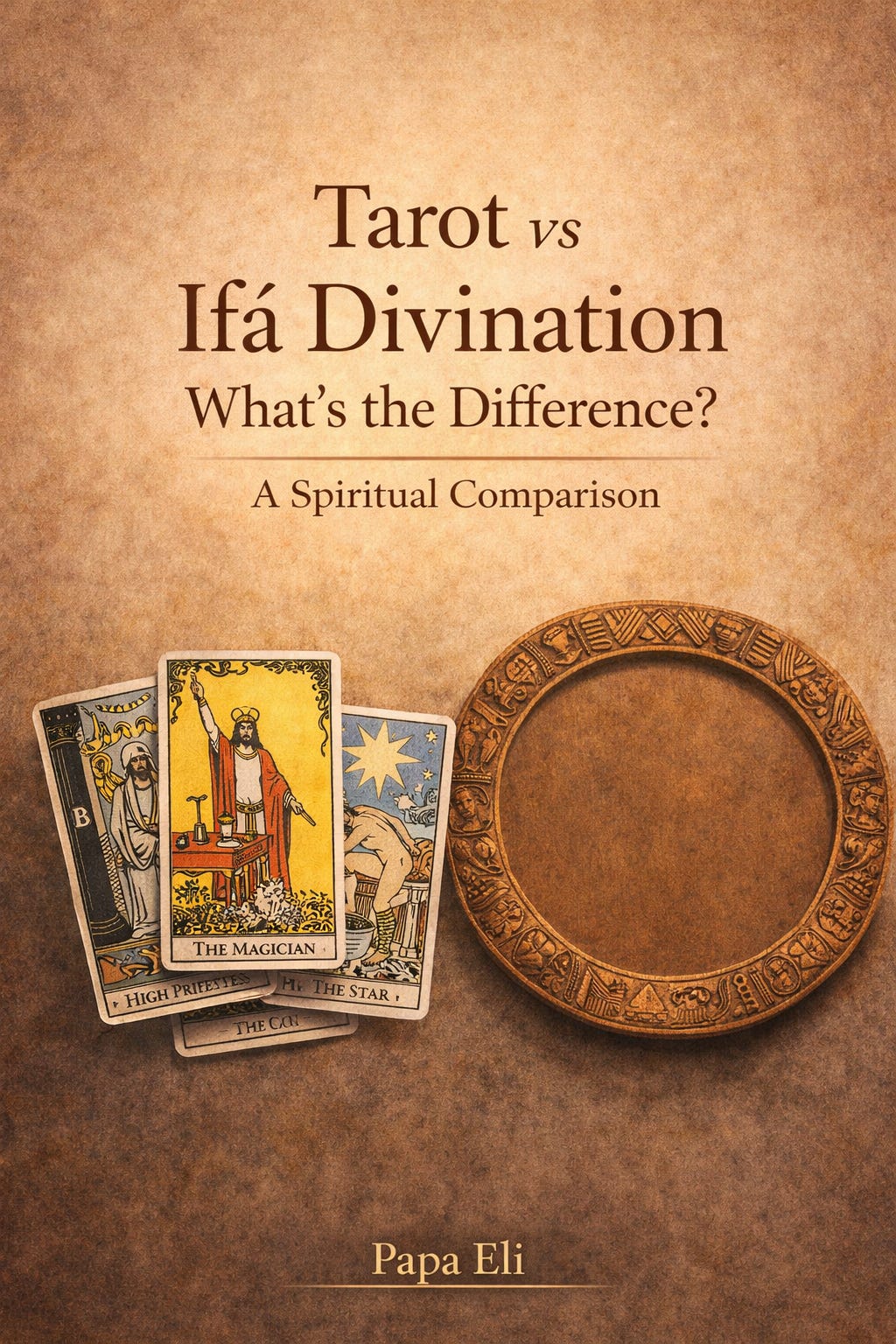
For as long as human beings have walked this earth, we have found ways to listen to the deeper currents running beneath our everyday lives. Tarot is one of those ways. Ifá is another. Understanding the difference between them, and what they share, says something important about both.
What Tarot Is
Tarot as we know it today originated in 15th century Europe, initially as a card game before evolving into a tool for divination and inner reflection. A standard Tarot deck contains 78 cards: 22 Major Arcana representing the major archetypes and turning points of human experience, and 56 Minor Arcana divided into four suits that speak to the textures of everyday life.
What makes Tarot work is not magic in the theatrical sense. It works because the imagery speaks to something universal in us. The cards function as mirrors. They surface what we already know but haven’t yet said out loud, and they give language to experiences that resist ordinary description. The reader brings skill and intuition. The querent brings their question and their willingness to hear. And somewhere in the space between them, something clarifying tends to happen.
What Ifá Is
Ifá is a sacred tradition originating from the Yoruba people of West Africa, and it is something considerably more than a divination system. It is an entire spiritual and philosophical corpus - a way of understanding the world, the soul, and the relationship between the two.
Ifá centers on the wisdom of Orunmila, the Orisha who witnessed the choices each soul made before entering this world. Its practice is carried by specially trained priests called Babalawos, or Iyanifa in the case of female priests, who spend years (sometimes decades) learning the sacred Ifá corpus. This is a vast body of oral literature containing hundreds of verses, stories, prescriptions, and prayers, each one linked to one of 256 sacred patterns called Odù.
When someone consults Ifá, the Babalawo or Iyanifa casts either palm nuts called Ikin, or a divination chain called the Opele. The pattern they fall in determines which Odù speaks, and from that Odù, the priest draws on deep knowledge to deliver guidance. That guidance is specific. It comes with direction, offerings to make, actions to take, things to change. The message is not left open to personal interpretation in the way a Tarot card is. It arrives with clarity and authority.
This is one of the most significant distinctions between the two systems. Tarot places the interpretive wisdom in the hands of the reader. Ifá places it in the tradition itself, transmitted through a priest who has dedicated their life to its keeping.
What They Share
For all their differences, Tarot and Ifá are reaching toward something very similar.
Both rest on the belief that there are unseen forces shaping our lives, and that those forces can be communicated with. Both use physical objects as bridges between the visible and invisible worlds. Both offer insight not just about what might happen, but about who you are and what your soul came here to do.
Ancestral connection runs through both as well. The Ifá corpus is, in a very real sense, the accumulated wisdom of generations of Yoruba ancestors speaking forward in time. And many Tarot practitioners, particularly in Black and African diaspora communities, approach their decks as tools for ancestral communication, setting up altars and treating their readings as genuine conversations with those who came before.
Neither system is fundamentally about prediction. They are about alignment. They are about understanding your path, your obstacles, and your gifts, and moving in a way that honors what your soul already knows.
Other Voices in the Conversation
Tarot and Ifá are two languages in a much wider human conversation. Cowrie shell divination, practiced across many African traditions, uses the position and orientation of cast shells to tell a story that connects the seeker to ancestral and spiritual forces. Bone throwing, found across African and indigenous traditions worldwide, reads the patterns of objects representing different dimensions of life. The I Ching from ancient China arrives at one of 64 hexagrams through the casting of coins or yarrow stalks, each with its own body of teaching (perhaps the closest structural relative to Ifá in the Eastern world). Astrology, practiced across Mesopotamia, India, China, and the Mediterranean long before the Common Era, maps human experience onto cosmic archetypes that have been studied and refined across thousands of years.
What unites all of these is a shared conviction: the universe is not silent. The answers we seek are not hidden from us. They’re only waiting for us to develop the ears to hear them.
A Word of Care
Not all divination systems are meant to be practiced by everyone, and that distinction matters.
Tarot is accessible by design. The tradition welcomes practitioners of all backgrounds. Ifá is different. It is a living sacred tradition with initiatory requirements, trained clergy, and deep community roots. Picking up an Orisha-themed oracle deck, while beautiful, is not the same as consulting a Babalawo or Iyanifa, and practitioners of the tradition are clear about that distinction.
This isn’t a reason to approach Ifá with fear or distance. It is simply a reminder that some traditions are so old, so complete, and so carefully tended that they deserve more than casual borrowing. Reverence and genuine curiosity are always the right starting point.
You Already Know How to Listen
What moves me most about all of this is the pattern it reveals. Human beings across every culture and every century have found their own way to do the same thing. To sit down. To get quiet. To create a ritual that says: I am here. I am ready to hear something true.
Whether that looks like laying out cards at your kitchen table or consulting a priest who has spent decades in service to a tradition, the underlying gesture is the same. We are not just physical creatures with to-do lists. We are souls navigating something larger than what we can see, and we have always known it.
The cards, the shells, the palm nuts - they are just different ways of remembering that.
Explore more articles on Tarot, Ifá, and divination traditions at Crossroads and Wellspring — Tea with Papa Eli. If you are curious about Ifa divination, contact Papa Eli directly, or Book a Reading.