


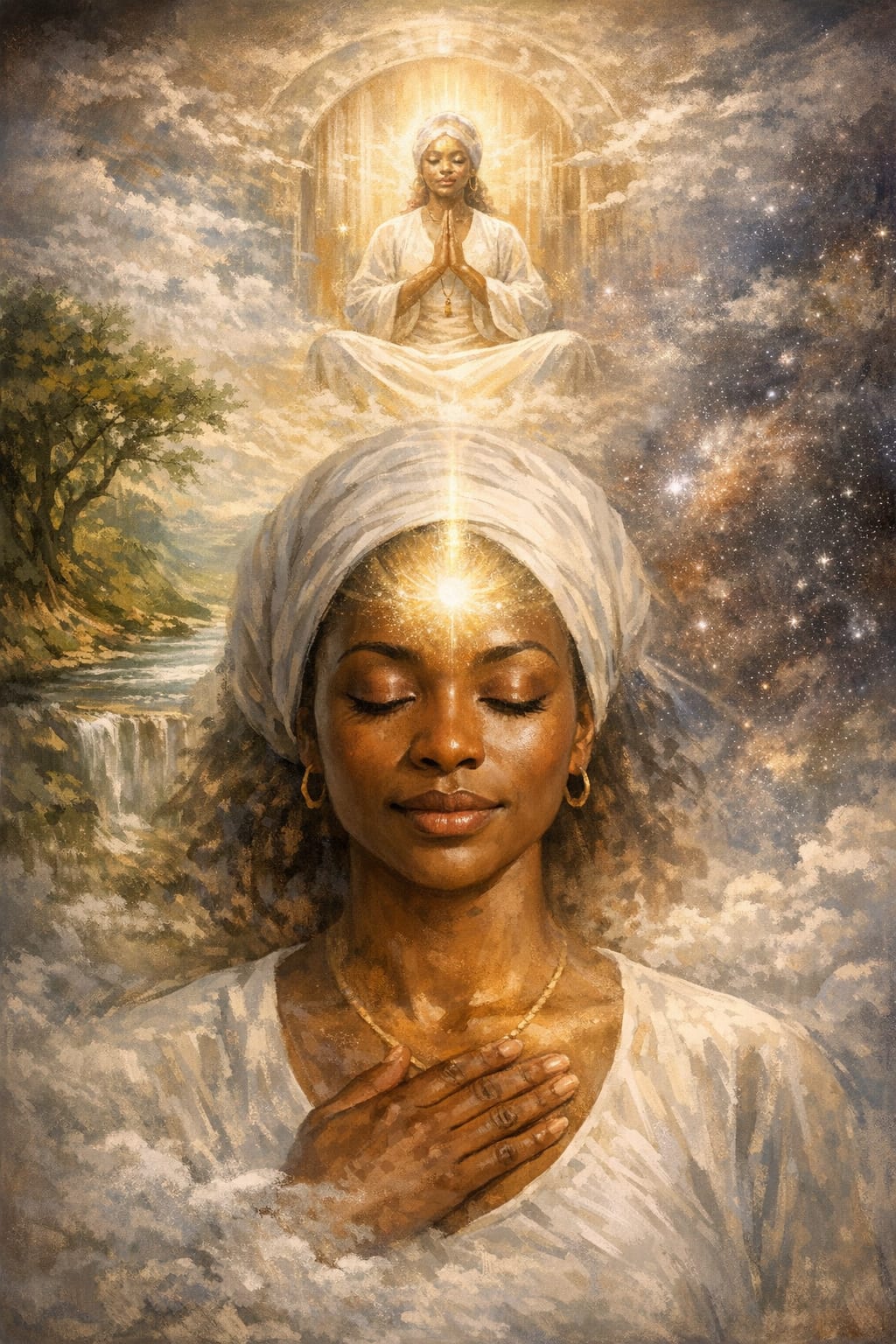
Have you ever had a moment where something just *felt* right because somewhere deep inside, you just *knew*?
That knowing has a name.
In Yoruba tradition, it’s called “Ori.”
So, What Exactly Is Ori?
The word Ori literally translates to “head” in Yoruba. But we’re not just talking about the physical head sitting on your shoulders. We’re talking about something far more expansive. Your Ori is your personal divine essence. Your higher self. The part of you that existed before you had this body, this life, or this name.
I’m gonna try my best to explain. In Yoruba cosmology, before you were born into this world, your soul stood before the divine and chose its Ori. You chose your path, your purpose, your spiritual blueprint, and then you arrived here in this skin, in this family, and in this time carrying that blueprint within you.
Ori is that blueprint, alive inside you right now.
What makes Ori so beautiful and so distinct from other concepts of the divine is how *personal* it is. While other forces and energies exist in the universe, Ori is uniquely yours. It knows your name. It knows your story. It was with you at the beginning, and it walks with you every step of the way.
The Two Faces of Ori
Here’s where it gets really interesting. Ori actually has two dimensions to it, and understanding both helps you see the full picture.
Ori Ode: The Outer Head
Ori Ode is the physical head. The one you can touch. The one people see. In Yoruba culture, the head is considered sacred in a very literal sense. It’s treated with reverence because it is the physical dwelling place of your Ori. This is why rituals and ceremonies often involve the head: anointing it, adorning it, honoring it. The body that houses your spirit deserves that kind of care.
Ori Inu: The Inner Head
And then there’s **Ori Inu**, the inner head. This is the one we’re really here to talk about. Ori Inu is your spiritual self, your higher consciousness, the divine intelligence that lives within you. It’s the part of you connected to something greater, something timeless.
Ori Inu is your intuition on its highest level. It’s that whisper that tells you *this isn’t the right path* even when everything on paper looks perfect. It’s the pull toward something you can’t always explain but can always feel. When folks talking about connecting with your higher self, they are really talking about aligning with Ori Inu.
Ayanmo: The Destiny You Chose
Wrapped up in the concept of Ori is something called **Ayanmo**. Ayanmo is your divine destiny or life purpose.
Now, before you start thinking this is just a fancy word for fate, stay with me. Ayanmo isn’t about being locked into a predetermined script with no say in the matter. It’s more nuanced than that. It’s the soul’s chosen mission, the reason you’re here, the deepest expression of who you are meant to be, but there is a beautiful tension in Yoruba Pholisophy. You see, Ayanmo is chosen, but the living of it is up to you. You can align with it or resist it. You can listen to your Ori or drown it out. Your destiny isn’t something that happens to you — it’s something that unfolds through you, as you learn to work with your Ori rather than against it.
Iponri: Your Heavenly Double
There’s one more piece of this that I find absolutely profound: the concept of Iponri. Your Iponri is essentially your spiritual counterpart — the version of your Ori that exists in the realm of spirit, in the place from which you came. Think of it as the fullest, most complete version of you. The you that hasn’t been shaped by hardship or doubt or the noise of the world. Pure. Whole. Aligned.
Your Iponri is always there, always whole, and always connected to your Ayanmo. When you do the work of honoring your Ori (when you pray to it, listen to it, nurture it) you’re essentially drawing closer to your Iponri. You’re closing the gap between who you are right now and who you truly are at your core.
Why Ori Comes First
Here’s something that stopped me in my tracks when I first learned it. In Yoruba tradition, Ori is considered the most important force to align with — even before any of the Orishas. Why? Because no Orisha, no matter how powerful, can intercede on your behalf if your Ori is not aligned. Your Ori is the intermediary between you and everything else. It’s the gatekeeper of your blessings, the navigator of your path. If your Ori isn’t with you — if you’re living out of alignment with your deeper self — all the prayers in the world may not land the way you hope. This isn’t meant to be intimidating. It’s actually deeply liberating. It means that the most important relationship you can cultivate is the one with yourself (your truest, highest self).
Coming Home to Yourself
So what does it mean to honor your Ori in everyday life? It means learning to listen (really listen) to your inner voice before the world gets loud. It means choosing paths that resonate with your soul, even when they’re harder to explain to others. It means treating your body, your mind, and your spirit with the kind of reverence you’d give to something sacred. Because here’s the thing, Beloved. You are something sacred. Your Ori isn’t something outside of you that you need to find. It’s not somewhere at the end of a long spiritual journey. It’s already here. It’s already you. The work isn’t to acquire it. The work is to return to it. Maybe that’s the most ancient, most human spiritual truth of all: that beneath all the layers of who we’ve been told to be, beneath the conditioning and the noise and the forgetting, there is something in us that already knows who we are.
Ori knows.
*What’s resonating with you here? I’d love to hear what your Ori has been whispering to you lately. Drop it in the comments below.*
—Papa Eli