


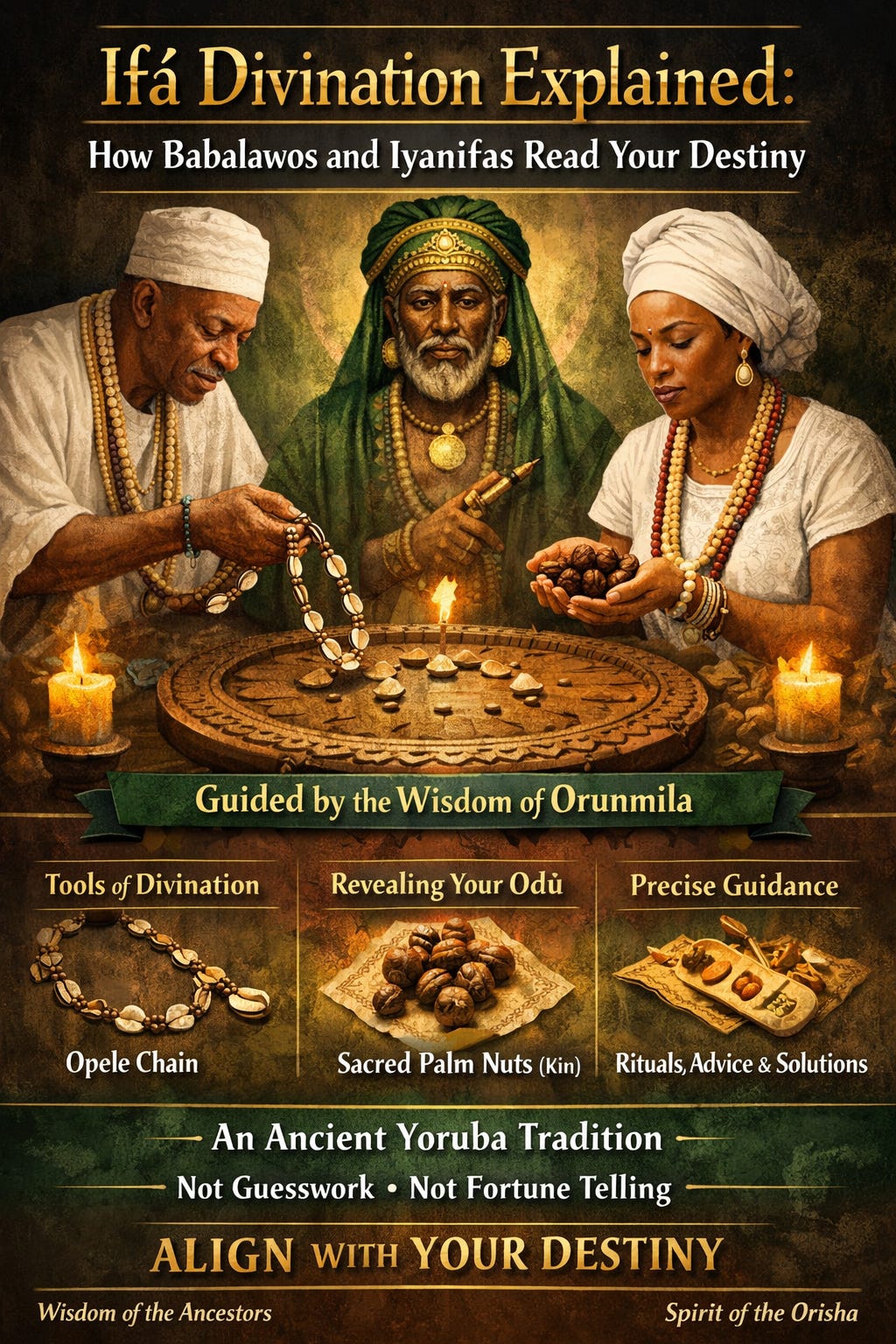
If you have ever sat across from a Babalawo or Iyanifa and experienced an Ifá consultation, you already know that what happens in that space is difficult to describe to someone who hasn’t been there. There is a precision to it that surprises people. That precision is not accidental, and it is not a performance. It is the result of a system so carefully constructed, so thoroughly tested across centuries of human experience, that it has survived the Middle Passage, colonization, forced religious conversion, and every other force that has tried to extinguish it. Ifá is still here because it works, and understanding how it works is the beginning of understanding why it deserves the reverence it receives.
What Ifá Actually Is
Ifá is not simply a divination system, though divination is central to it. It is a complete spiritual and philosophical tradition originating from the Yoruba people of West Africa, specifically from what is now southwestern Nigeria. At its heart is Orunmila, the Orisha of wisdom and divination, who is understood to have witnessed the destiny each soul chose before entering this world. Orunmila does not predict the future in the way a fortune teller might. He reveals what is already true: the shape of a person’s path, the forces working for and against them, and what is needed to move in alignment with their destiny rather than against it.
This is a meaningful distinction. Ifá does not tell you what will happen to you. It tells you what is happening, what has been set in motion, and what you can do about it. The consultation is an act of alignment, not prediction.
The Priests Who Carry the Tradition
Ifá is transmitted through a trained priesthood. Male priests are called Babalawo, a Yoruba word meaning “father of the mysteries.” Female priests are called Iyanifa, meaning “mother of Ifá” Both undergo years of rigorous training and initiation before they are qualified to divine on behalf of others, and that training is not casual or self-directed. It happens within the tradition, under the guidance of elders, and it encompasses not just the mechanics of divination but the vast body of sacred knowledge that gives the divination its meaning.
That body of knowledge is called the Ifá corpus, and it is one of the most extraordinary oral literatures in human history. It contains 256 sacred patterns called Odù, and within each Odù lives a world of verses, stories, teachings, warnings, prescriptions, and proverbs accumulated over generations of priests who dedicated their lives to its preservation. When UNESCO inscribed the Ifá corpus on its list of Intangible Cultural Heritage of Humanity in 2005, it was recognizing something that practitioners have always known - that this is not folk wisdom or superstition. It is a civilization’s accumulated understanding of the human condition, encoded in a form designed to survive.
How the Consultation Works
When someone consults Ifá, the Babalawo or Iyanifa uses one of two primary instruments to divine. The first is Ikin, the sacred palm nuts that are cast and counted in a specific way to generate a pattern. The second is the Opele, a divining chain made of eight lobes that is cast in a single motion and read from the pattern in which it falls. Both instruments are tools for arriving at the same destination which is the identification of the Odù that is speaking for the person in that moment.
Once the Odù is identified, the Babalawo or Iyanifa draws on their deep knowledge of that Odù’s corpus to deliver the reading. This is where the years of training become visible. The priest is not interpreting symbols according to personal intuition. They are drawing from a vast reservoir of memorized sacred literature to identify which verses are speaking, what they are saying, and what they are prescribing. Ifá readings come with specific guidance (offerings to make, actions to take, things to change, protections to put in place). The message does not leave you wondering what to do with it.
What Makes Ifá Different
People who come to Ifá from a background in Tarot or other divination systems often notice something immediately: the agency sits in a different place. In Tarot, the reader brings their intuition to bear on the imagery and the querent brings their own interpretation to the reading. The wisdom, in a sense, lives between the two people in the room. In Ifá, the wisdom lives in the tradition itself, and the Babalawo or Iyanifa is its trained vessel. Their years of study exist precisely so that the message can come through accurately, without the distortion of personal bias or untrained interpretation.
This is one of Ifá’s greatest strengths. The tradition has spent centuries refining its understanding of the human experience and encoding that understanding in a form that can be transmitted with precision. When you sit with a Babalawo or Iyanifa, you are not just sitting with one person’s insight. You are sitting with the accumulated wisdom of a lineage.
What a Consultation Is Not
It is worth being clear about a few things, because there is a great deal of misunderstanding about what Ifá consultation involves and what it promises.
Ifá is not magic in the theatrical sense, and a Babalawo or Iyanifa is not a sorcerer. The consultation is a spiritual and practical conversation about your life, your path, and what you need to move forward in alignment with your destiny. It requires your honest participation. You get out of it what you bring to it in terms of openness and willingness to hear what is true rather than what is comfortable.
Ifá also does not remove your agency. The guidance that comes through a consultation points you toward choices, not conclusions. Orunmila reveals the path. What you do with that information is still entirely yours to decide.
And finally, a word of respect: Ifá is a living sacred tradition with deep roots in community, initiation, and lineage. It is not a product, and it is not interchangeable with other spiritual tools. Approaching it with genuine reverence is not just good manners. It is the only posture from which the tradition can actually reach you.
Why People Come to Ifá
People come to Ifá for the same reasons people come to any divination. They are at a crossroads. They are carrying something they cannot name. They sense that something in their life is out of alignment but cannot see clearly enough to understand why. They want to know what their life is actually asking of them, not what they wish it were asking.
What they tend to find, when they arrive with that kind of honest seeking, is a tradition that has been waiting for exactly that question for a very long time.
Papa Eli
Explore more on Ifá, Orisha wisdom, and African diaspora spirituality at Crossroads and Wellspring — Tea with Papa Eli.
You can also Book a session.