


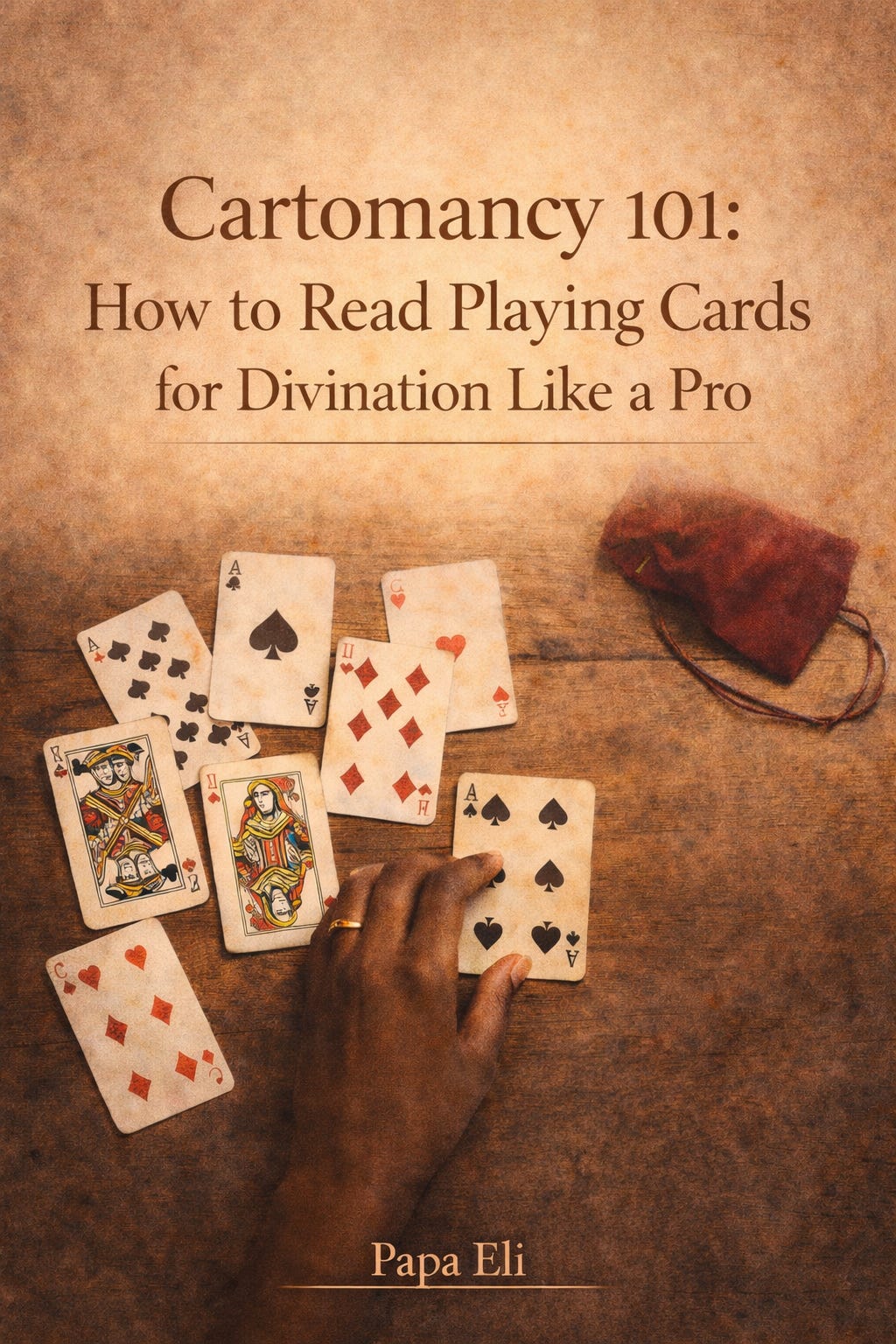
There is something quietly radical about cartomancy. You don’t need a specialized deck with mystical imagery, or a guidebook the size of a small dictionary. You only need an ordinary deck of playing cards and the willingness to learn what its been trying to say all along.
Cartomancy is the practice of divination using a standard 52-card playing deck. It is one of the oldest and most accessible forms of card reading in the world, with roots tracing back to 14th century Europe when playing cards first arrived from the East. Long before Tarot became widely known, ordinary people were using ordinary cards to seek guidance, read fortunes, and interpret the currents of their lives. The tradition never disappeared. It just got quiet.
If you’ve ever been curious about card reading but felt intimidated by the complexity of Tarot, cartomancy is an excellent place to begin. And if you’re already a Tarot reader, cartomancy offers a different kind of clarity thats stripped down, direct, and surprisingly deep.
Understanding the Deck
A standard playing deck contains 52 cards divided into four suits: Hearts, Spades, Clubs, and Diamonds. Each suit governs a broad domain of human experience, and within each suit, the numbered cards and face cards carry their own specific meanings.
Hearts correspond to the emotional and relational dimensions of life: love, family, friendship, matters of the heart in the most literal sense. When Hearts dominate a reading, the question at hand is fundamentally an emotional one.
Spades represent challenge, conflict, and the harder truths. They are associated with difficulty, loss, change, and the kind of clarity that only comes through adversity. A reading heavy with Spades is not a bad omen so much as an honest one.
Clubs speak to ambition, work, communication, and movement. They carry an active, forward-leaning energy and often appear when questions involve career, effort, and the building of something.
Diamonds govern the material world — money, resources, practical matters, and earthly security. When Diamonds are prominent, the reading is asking you to pay attention to the tangible dimensions of your situation.
The Face Cards
The face cards — Jacks, Queens, and Kings — traditionally represent people, either actual individuals in the querent’s life or aspects of the querent themselves.
Jacks represent younger people or the more youthful, impulsive energies in a situation. Queens represent mature feminine energy — nurturing, intuitive, perceptive. Kings represent mature masculine energy — authority, decisiveness, and mastery. The suit of each face card colors its meaning. A King of Hearts is a warm, emotionally intelligent authority figure. A King of Spades is sharper — analytical, demanding, and not always comfortable to be around.
The Joker, when included, functions similarly to the Fool in Tarot — the wildcard, the unexpected, the energy of something entirely outside the known pattern.
The Aces
The four Aces hold special weight in cartomancy. They represent beginnings and pure potential — the raw, undiluted energy of their suit before it takes any particular shape.
The Ace of Hearts signals new emotional beginnings — a new relationship, a healing, an opening of the heart. The Ace of Spades is the most powerful card in the deck and one of the most complex. It speaks to transformation, endings that make way for something new, and deep truth that cannot be avoided. The Ace of Clubs brings new energy around work, communication, and creative endeavor. The Ace of Diamonds signals new financial or material opportunity.
How to Begin Reading
Before you read for anyone else, read for yourself. Get familiar with how the cards speak to you personally. Different readers develop slightly different associations over time, and that is not a flaw in the system — it is how the system works. Your intuition is part of the instrument.
Start with a simple three-card draw. Lay three cards face down and turn them over one at a time, left to right. The first card represents the past — what has led to this moment. The second represents the present — what is currently at work. The third represents the likely outcome if current energies continue.
Don’t rush to assign meaning before you’ve looked at the spread as a whole. Notice what suits are present. Notice if the cards feel heavy or light, encouraging or cautionary. Let the story form before you start interpreting individual cards.
As you grow more comfortable, you can expand to larger spreads and more complex questions. But the three-card pull will serve you remarkably well for a very long time.
A Few Principles Worth Keeping
Reading cards well is less about memorizing meanings and more about learning to think in the language of the cards. A few things will help you do that.
Context shapes meaning. A difficult card surrounded by supportive ones reads differently than the same card in an otherwise troubled spread. Never interpret a card in isolation.
The question matters. Vague questions produce vague readings. The more specific and honest you are about what you’re actually asking, the more useful the response will be.
Reversals are optional. Some cartomancy readers use reversed card meanings, where a card drawn upside down carries a modified or blocked version of its energy. Others don’t. There is no universal rule here. Find what works for you and be consistent.
And finally, read with respect. Whether you approach cartomancy as a spiritual practice, a meditative exercise, or a tool for reflection, the deck responds to the energy you bring to it. Come to it honestly, and it will return the favor.
The Cards Have Always Been Talking
What I find most compelling about cartomancy is its democratizing spirit. This is not an esoteric tradition locked behind years of study or available only to those with access to specialized materials. It is available to anyone willing to pay attention. The deck in your drawer has always been a potential oracle. It was only waiting for you to ask.
Explore more on cartomancy or find out what the cards are saying to you. Book a Reading with Papa Eli.